Top Types of Animal Feed for Global Buyers
Global buyers rarely purchase animal feed by category alone. They assess species, age, production goals, climate, storage conditions, and local compliance requirements. A dairy farm in northern Europe may prioritize high-energy silage and protein balance. A poultry producer in Southeast Asia may need stable corn, soybean meal, premixes, and reliable delivery schedules. These differences make feed selection practical, not theoretical.
This guide examines the top types of all animal feed traded across international markets. It covers forage, grains, oilseed meals, compound feed, mineral supplements, feed additives, and species-specific formulas. Each section considers nutritional purpose, sourcing factors, quality indicators, and common purchasing risks. Moisture content matters. So does particle size. Even a clean-looking shipment can fail when storage temperatures rise or documentation remains incomplete.
Dr. Harinder P.S. Makkar, a former FAO animal nutrition expert, states, “Feed safety is an integral part of food safety.” His point remains central for every buyer, supplier, and feed manufacturer. Traceability, laboratory testing, and transparent labeling should guide commercial decisions. Price alone is a weak measure of value.
No single feed fits every farm. That is easy to forget.
The market also contains uncertainty. Crop quality changes between seasons. Transport delays can affect freshness. Some buyers may overestimate the value of popular additives without reviewing verified performance data. Careful comparison is essential. With practical experience, technical knowledge, and responsible sourcing, global buyers can select feed that supports animal health, production efficiency, and dependable long-term supply.
Animal Feed Basics and Its Role in Livestock Production
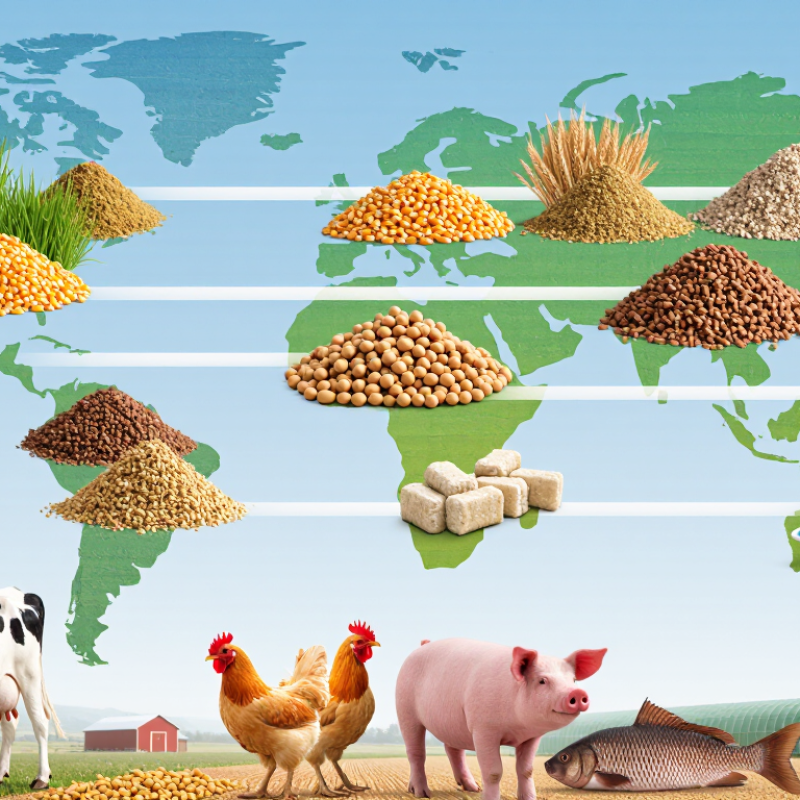
Animal feed supplies the energy, protein, fiber, vitamins, and minerals animals need to grow, reproduce, and produce milk or eggs. A ration is not one recipe. Its ingredients and nutrient balance depend on species, age, production stage, and local feed availability. A dairy cow, for example, may receive forage alongside a measured grain mix; young poultry need a carefully balanced diet for rapid growth. Small changes matter.
Feed also links livestock farming with the wider food system. FAO’s 2017 analysis estimated that livestock consume about 6 billion tonnes of feed dry matter each year, with 86% made from materials humans cannot currently eat. This includes grass, crop residues, and some processing by-products. OECD-FAO’s Agricultural Outlook 2024-2033 projects global meat consumption will rise about 12% by 2033, increasing pressure to use feed resources efficiently. Yet efficiency figures do not tell the whole story: ingredient quality, storage losses, and animal health can vary sharply between farms. A dusty sack or damp silo can quietly reduce feed value. Feed plans therefore need regular review, not just a fixed formula.
Top Types of Animal Feed for Global Buyers - Animal Feed Basics and Its Role in Livestock Production
| Feed Type | Common Examples | Typical Nutritional Role | Common Livestock Uses | Role in Production | Key Buyer Considerations |
|---|---|---|---|---|---|
| Pasture and fresh forage | Grazed grasses, clovers, and other suitable legumes | Provides fiber, energy, and—depending on plant species and growth stage—protein and minerals. | Cattle, sheep, goats, and horses | Forms a major part of diets for grazing animals and can reduce reliance on purchased feed when supply is adequate. | Assess seasonal availability, plant maturity, grazing management, and suitability for the animal species. |
| Hay and other dried forages | Grass hay, alfalfa hay, and legume hay | Provides long-fiber roughage; nutrient content varies with crop type, harvest timing, and storage. | Cattle, sheep, goats, and horses | Supplies forage when pasture is limited and supports rumen function in ruminant diets. | Check moisture, leaf retention, odor, visible mold, foreign material, and laboratory nutrient analysis where appropriate. |
| Silage and fermented forage | Maize (corn) silage, grass silage, and legume silage | Provides conserved forage, with energy and fiber levels depending on the crop and harvest stage. | Primarily cattle; also used in some sheep and goat diets | Preserves harvested crops for later feeding and helps maintain a more consistent forage supply. | Review fermentation quality, storage integrity, spoilage, dry matter, and safe handling requirements. |
| Cereal grains and energy feeds | Maize, wheat, barley, sorghum, and oats | Generally concentrated sources of energy; protein and fiber levels differ among grains. | Cattle, pigs, poultry, and other livestock, as part of balanced rations | Raises dietary energy density to support growth, maintenance, or production when matched to the animal’s needs. | Check grain quality, moisture, cleanliness, mycotoxin risks, processing requirements, and local feed regulations. |
| Oilseed meals and protein feeds | Soybean meal, canola meal, and sunflower meal | Concentrated protein sources; nutrient composition varies by source and processing method. | Cattle, pigs, poultry, and other livestock in formulated diets | Helps meet protein and amino acid requirements when included at appropriate levels in a balanced ration. | Confirm origin, processing quality, nutrient specification, traceability, and compliance with applicable safety rules. |
| Brans and other milling by-products | Wheat bran, rice bran, and selected cereal-processing co-products | May contribute fiber, energy, protein, or minerals; composition varies by material and processing. | Cattle, sheep, goats, and pigs, depending on product and formulation | Can provide useful nutrients and diversify ingredient sourcing when included at suitable levels. | Verify the exact material, nutrient analysis, freshness, contamination controls, and any inclusion limits. |
| Compound feed and complete feed | Pelleted, mash, or crumbled feeds formulated for a species or production stage | Combines selected energy, protein, fiber, mineral, and vitamin ingredients to meet a defined dietary purpose. | Poultry, pigs, cattle, aquaculture species, and other livestock, depending on formulation | Provides a consistent ration or a targeted supplement; a complete feed is designed to serve as the main diet for its stated use. | Match the label to species and life stage; review guaranteed analysis, directions, storage instructions, and feed safety documentation. |
| Mineral and vitamin supplements | Salt, mineral mixes, trace-mineral sources, and vitamin premixes | Supplies selected minerals and vitamins that may be insufficient in the basal diet. | All livestock species, with formulation and dosage specific to the animal and diet | Helps balance nutrient requirements and supports normal growth, reproduction, and body functions. | Follow the stated inclusion rate; avoid excessive or duplicate supplementation and confirm compatibility with the full ration. |
Feed value varies with species, life stage, crop variety, growing conditions, processing, and storage. Use product-specific analysis and qualified nutrition advice when formulating livestock diets.
Related Posts
-
Why Choose All Animal Feed for Global Sourcing?
-
10 Best Animal Feed Products for Healthier Livestock in 2023
-
2026 Best Animal Feed Suppliers for Global Buyers
-
What Are the Top Types of All Animal Feed in 2026?
-
Why Is Animal Feed Important for Global Buyers?
-
Top Animal Feed Tips for Global Buyers to Consider